
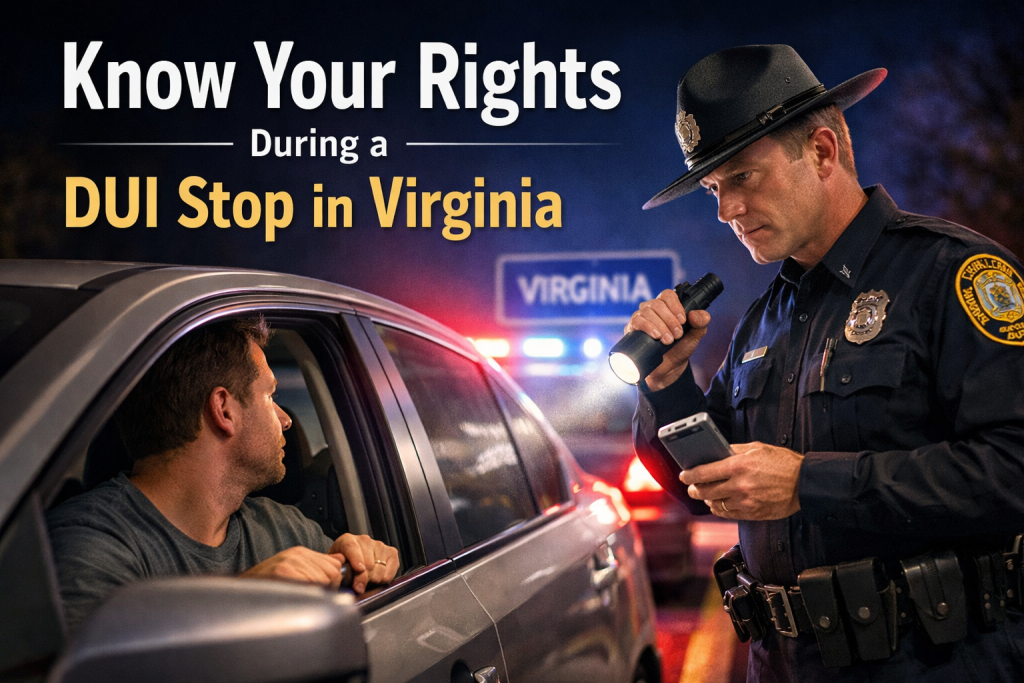
Know Your Rights During a DUI Stop in Virginia
Being pulled over on suspicion of driving under the influence can be stressful and confusing. Many people do not know what they are legally required to do, what they can refuse, and what steps may affect their case later. If you are stopped for suspected DUI in Virginia, understanding your rights can help you stay calm, avoid unnecessary mistakes, and protect yourself if charges are filed.
This article explains what drivers should know about a DUI stop in Virginia, including your rights during the traffic stop, field sobriety testing, chemical testing, searches, and police questioning. While every situation is different, knowing the basics can make a major difference.
Why Knowing Your Rights Matters in Virginia DUI Cases
A DUI investigation often begins before an arrest is made. An officer may claim to observe weaving, speeding, delayed braking, or another traffic issue. From that point forward, the officer is gathering evidence that may later be used in court. What you say, how you respond, and whether you understand your legal rights can all affect the outcome of the case.
Virginia treats DUI allegations seriously. A conviction can lead to fines, license suspension, alcohol education requirements, increased insurance costs, and possible jail time. Because the consequences are significant, it is important to know your rights from the moment you see flashing lights in your rearview mirror.
What to Do When You Are Pulled Over
Stay calm and pull over safely
If police signal you to stop, pull over as soon as it is safe to do so. Turn off the car, keep your hands visible, and avoid sudden movements. These simple steps can help prevent the situation from becoming more tense.
Provide basic identifying documents
In Virginia, you are generally expected to provide your driver’s license and vehicle registration when lawfully requested. If asked for proof of insurance, you should provide that as well if available. Refusing to provide identifying information can lead to additional problems.
Be polite, but do not volunteer information
You should be respectful, but you do not have to answer potentially incriminating questions in detail. For example, an officer may ask whether you have been drinking, where you are coming from, or how many drinks you had. Many people think they can talk their way out of trouble, but these statements are often used against them later.
A simple and respectful response such as, “I would prefer not to answer questions without legal advice,” may be appropriate in some cases. Remaining polite is important, even if you choose not to answer.
Your Right to Remain Silent
One of the most important rights in a Virginia DUI stop is the right to remain silent. This does not mean you can ignore every request from police. You still must comply with lawful instructions such as providing identification and stepping out of the vehicle if ordered to do so. However, you do not have to answer questions designed to gather evidence of impairment.
For example, if an officer asks whether you drank at dinner, what time you left the bar, or whether you feel intoxicated, your answers may become part of the prosecution’s case. Even statements that seem minor or harmless can be misunderstood or taken out of context.
Invoking your right to remain silent should be done calmly and clearly. Do not argue with the officer or become confrontational. The goal is to protect your rights without escalating the encounter.
Can Police Search Your Car During a DUI Stop?
Drivers often assume police can search a vehicle whenever they suspect DUI, but that is not always true. In many cases, officers need consent, a warrant, or a legally recognized exception to the warrant requirement. There are situations where a search may be allowed, such as when evidence is in plain view or when police claim probable cause.
However, you do not have to give consent to a search. If an officer asks, you may politely say, “I do not consent to a search.” This does not guarantee the officer will not search the vehicle anyway, but it can help preserve an important legal issue for your defense.
If a search did occur, an attorney can later evaluate whether it was lawful and whether any evidence should be challenged in court.
Field Sobriety Tests in Virginia
What are field sobriety tests?
Field sobriety tests are roadside exercises officers use to look for signs of impairment. These may include standing on one leg, walking heel to toe, or following an object with your eyes. Officers often present these tests as routine, but they are subjective and can be affected by many factors unrelated to alcohol or drugs.
Do you have to take them?
In many Virginia DUI stops, roadside field sobriety tests are not the same as the post-arrest chemical test required under implied consent rules. These roadside exercises may carry risks because poor performance can be used as evidence against you. Medical issues, anxiety, fatigue, uneven pavement, age, footwear, or weather conditions can affect how a person performs.
Whether to participate is a decision with legal consequences, and the best choice may depend on the facts. Because the law and practice can be nuanced, it is wise to discuss the issue with a Virginia criminal defense lawyer if you were arrested after refusing or taking field sobriety tests.
Preliminary Breath Testing at the Roadside
During a DUI stop, an officer may ask you to blow into a handheld roadside device. This is often called a preliminary breath test. People frequently confuse this with the official chemical test given after arrest.
The roadside breath device is generally used by police during the investigation phase. The legal effect of refusing a roadside test may differ from refusing an official test after arrest. Because these distinctions matter, anyone facing a DUI charge in Virginia should seek legal advice right away to understand what happened and whether law enforcement followed proper procedures.
Virginia Implied Consent and Official Chemical Testing
What happens after an arrest?
If you are lawfully arrested for DUI in Virginia, implied consent laws may require you to submit to an official breath or blood test in certain circumstances. Refusing this test can trigger separate consequences, including license-related penalties, even apart from the DUI charge itself.
Why this stage is so important
Many drivers do not realize that the legal analysis changes after an arrest. What may be optional during the roadside investigation may become mandatory under Virginia law once a lawful arrest occurs. This is one of the most misunderstood parts of a DUI case.
If you refused an official test or believe the arrest was improper, an attorney may be able to examine whether police had legal grounds for the stop, the arrest, and the testing procedure.
Your Right to a Lawyer After a Virginia DUI Arrest
If you are arrested, you should ask to speak with a lawyer as soon as possible. Early legal guidance can be critical in a DUI case. A defense attorney can assess whether the traffic stop was lawful, whether police had probable cause, whether any statements should be suppressed, and whether chemical testing was administered correctly.
Prompt legal help can also assist with practical concerns such as license issues, court dates, and steps you may need to take to protect your driving privileges. For many people in Virginia, the period immediately after arrest is when important deadlines begin to run.
Common Mistakes People Make During a DUI Stop
Talking too much
People often try to explain away their driving or minimize how much they drank. Unfortunately, these statements can strengthen the prosecution’s case.
Consenting to searches without thinking
Some drivers agree to a vehicle search because they feel pressured. Politely refusing consent may preserve your rights.
Arguing with police
Even if you believe the stop is unfair, roadside arguments usually make matters worse. Stay calm and save your defenses for court.
Assuming guilt because of an arrest
An arrest is not a conviction. There may be legal defenses based on the stop, officer observations, testing methods, or constitutional issues.
Practical Example of a Virginia DUI Stop
Imagine a driver leaving a restaurant in Arlington, Virginia after having one drink with dinner. An officer stops the vehicle for allegedly drifting within the lane. The officer then asks if the driver had anything to drink. Nervous and wanting to be honest, the driver says, “Just a couple.” The officer asks the driver to perform roadside tests on a sloped shoulder while traffic passes by.
In that scenario, the driver’s statement and roadside performance may both become evidence, even if the driver was not actually impaired. This example shows why knowing your rights in Virginia matters. A person can make damaging admissions or appear unsteady for reasons that have nothing to do with intoxication.
How a DUI Defense Lawyer Can Help in Virginia
A DUI charge is not just about whether alcohol was involved. It is also about whether police followed the law at every stage. A defense lawyer may review dashcam footage, body camera video, testing records, witness statements, and the officer’s reasons for the stop and arrest.
Depending on the facts, a lawyer may challenge the legality of the traffic stop, the reliability of field observations, the administration of breath or blood testing, or the admissibility of statements made during questioning. For potential clients searching for answers after a DUI stop in Virginia, this legal review can be essential.
Protect Your Rights After a DUI Stop in Virginia
If you were stopped or arrested for DUI in Virginia, do not assume the case is straightforward or that you have no defense. Knowing your rights can help you avoid common mistakes, and getting legal advice quickly can help you understand your options.
Every DUI case is fact specific. If you have questions about a traffic stop, chemical test refusal, vehicle search, or your right to remain silent, speaking with an experienced criminal defense attorney can help you protect your future and make informed decisions.