
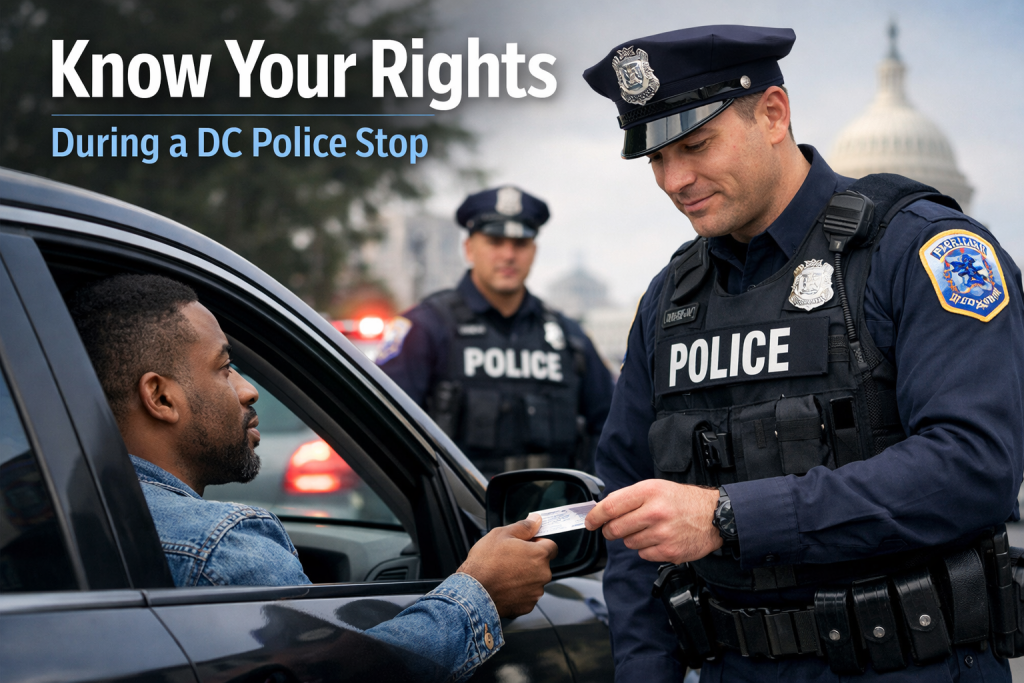
Know Your Rights During a Police Stop in Washington, DC
Being stopped by police can be stressful, confusing, and intimidating. Many people are unsure what they must do, what they can refuse, and how to protect themselves without making the situation worse. If you live in or visit Washington, DC, understanding your rights during a police stop can help you stay calm and make informed decisions.
This guide explains the basics of what to expect during a police stop in Washington, DC, including what information you may need to provide, when officers may search you, and how to respond respectfully while protecting your legal rights. While every case is different, knowing these general rules can make a meaningful difference if you are later accused of a crime or believe your rights were violated.
What Counts as a Police Stop?
A police stop happens when an officer temporarily detains a person for investigation. In Washington, DC, this may happen on the street, in a car, on public transportation, or near a business or home. Not every interaction with police is legally the same.
Consensual encounters
Sometimes an officer may approach you and ask questions without actually detaining you. In that situation, you may be free to leave. A simple example is an officer asking if you saw an incident nearby. If a reasonable person would feel free to walk away, the interaction may be considered voluntary.
Investigative stops
An officer may also stop you if they have a legal basis to briefly investigate possible criminal activity. This is often called a stop based on reasonable suspicion. For example, if an officer believes someone matches the description of a person involved in a recent theft, they may briefly detain that person to ask questions.
Arrests
An arrest is more serious than a temporary stop. If you are arrested, the officer must generally have probable cause to believe you committed a crime. Once the interaction moves from a brief detention to an arrest, different legal rules may apply.
Do You Have to Answer Questions?
One of the most common concerns during a police stop is whether you must answer an officer’s questions. In many situations, you have the right to remain silent. That means you do not have to answer questions about where you were, what you were doing, or whether you were involved in a suspected offense.
A calm and respectful response is often the safest approach. You may say, I am exercising my right to remain silent or I would like to speak with a lawyer. These statements help make your position clear.
At the same time, it is important not to argue, run, or physically resist the officer. Even if you believe the stop is unfair or unlawful, resisting in the moment can lead to additional charges or increase the risk of harm. Challenges to police conduct are usually handled later through your attorney and the court system.
Do You Have to Show Identification in Washington, DC?
This issue can be more complicated than people expect. In some situations, you may be required to identify yourself, especially if you are driving a vehicle. Drivers in Washington, DC, are generally expected to provide a valid license, registration, and proof of insurance during a lawful traffic stop.
If you are stopped while walking, the answer may depend on the circumstances. A police officer may ask for your name or identification, but the legal obligation to provide it is not always automatic in every street encounter. Because the details matter, it is often wise to avoid guessing or making false statements. Giving a fake name or false documents can create serious legal problems.
If you are unsure how to respond, you can remain polite and ask, Am I free to leave? If the officer says yes, you may calmly walk away. If the officer says no, the stop is no longer voluntary, and you should avoid resistance while protecting your rights as best you can.
When Can Police Search You?
Many people assume police can search them anytime they are stopped. That is not necessarily true. In Washington, DC, an officer generally needs legal justification to search your body, clothing, belongings, or vehicle.
Pat-downs for weapons
During certain investigative stops, an officer may conduct a limited pat-down of outer clothing if they reasonably believe you may be armed and dangerous. This is not supposed to be a full search for evidence. It is intended to check for weapons for officer safety.
Searches based on consent
An officer may ask, Do you mind if I search you? or Can I look in your bag? You usually have the right to refuse consent. A clear response such as I do not consent to a search may help preserve your legal position later. Refusing consent does not mean you are guilty, and in many situations, it is an important right.
Searches incident to arrest
If you are lawfully arrested, police may be allowed to search you and, in some cases, areas within your immediate reach. The exact scope of that search depends on the facts.
Vehicle searches
Car searches involve additional legal issues. Officers may search a vehicle if the driver consents, if they have probable cause, or in certain situations connected to an arrest. If you are pulled over in Washington, DC, it is usually best not to give consent to a vehicle search unless advised by counsel.
What Should You Do During a Traffic Stop?
Traffic stops can escalate quickly, especially if the driver or passengers appear nervous or confrontational. Practical steps can reduce risk and protect your rights.
Stay calm and visible
Pull over safely, keep your hands where the officer can see them, and avoid sudden movements. If it is dark, turning on the interior light may help show cooperation.
Provide basic driving documents
If you are the driver, provide your license, registration, and insurance when requested. Passengers may have different obligations depending on the circumstances.
Do not volunteer extra information
You do not need to explain where you are coming from, where you are going, or whether you drank earlier unless advised by counsel or legally required in a specific context. Short, respectful answers are usually best.
Do not consent to a search
If asked for permission to search your car, you may say, I do not consent to any searches. If officers search anyway, do not interfere physically. Your attorney can later review whether the search was lawful.
Common Example in Washington, DC
Imagine a person leaving a late-night convenience store in Northwest Washington, DC. Police stop him because a nearby caller reported suspicious activity by someone wearing similar clothing. The officer asks where he is coming from and whether he has anything illegal on him. The officer then asks to search his backpack.
In that situation, the person may have the right to remain silent and may refuse consent to search the backpack. If the officer has a specific reason to believe the person is armed, a limited pat-down may be allowed. But that does not automatically give police the right to search every personal item without further legal justification.
These situations often turn on small details, including what the officer observed, what was said, how long the stop lasted, and whether the person truly agreed to a search. That is why early legal advice can be so important.
What If Police Violate Your Rights?
If police obtained evidence through an unlawful stop or search, your lawyer may be able to challenge that evidence in court. In some criminal cases, illegally obtained evidence can be suppressed, meaning the prosecution may not be allowed to use it.
Potential issues may include stopping someone without sufficient legal basis, conducting a search without consent or lawful grounds, prolonging a stop without justification, or questioning a person after arrest without honoring constitutional protections.
Even if you think your rights were violated, the best step is usually to document what happened as soon as possible. Write down the date, time, location, officer information if known, names of witnesses, and what was said. Then contact a criminal defense attorney familiar with Washington, DC law.
When to Contact a Criminal Defense Lawyer
You should speak with a lawyer as soon as possible if you were arrested, charged, searched, or believe police found evidence after an unlawful stop. Early legal intervention can help protect your rights, preserve defenses, and prevent mistakes that may hurt your case.
A lawyer can review body camera footage, police reports, witness statements, and the timeline of the stop to determine whether officers acted lawfully. In many cases, the legality of the stop itself becomes a key issue in the defense.
Final Thoughts
Knowing your rights during a police stop in Washington, DC can help you respond calmly and protect yourself. You may have the right to remain silent, the right to refuse consent to a search, and the right to speak with a lawyer. At the same time, it is important to stay respectful and avoid physical resistance, even if you believe the officer is wrong.
If you or a loved one was stopped, searched, or arrested in Washington, DC, speaking with an experienced criminal defense attorney can help you understand your options and take the next steps with confidence.