
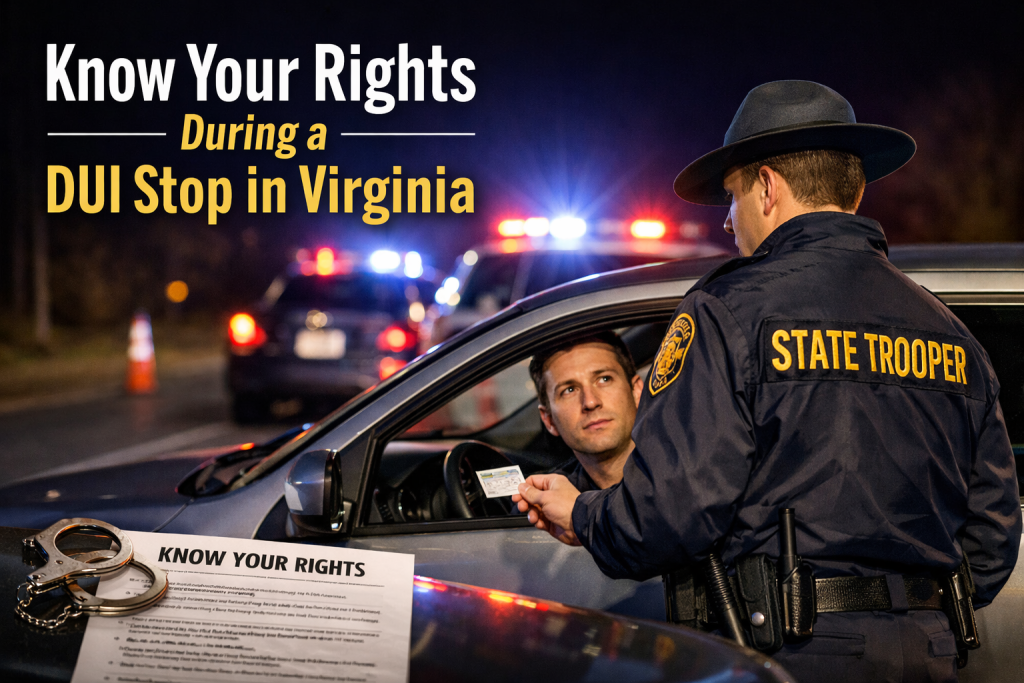
Know Your Rights During a DUI Stop in Virginia
Being stopped by police on suspicion of driving under the influence can be stressful and confusing. Many drivers are unsure what they must do, what they may refuse, and how a simple traffic stop can turn into a criminal case. Understanding your rights during a DUI stop in Virginia can help you avoid mistakes and protect your legal position.
In Virginia, DUI investigations often begin with a traffic stop for speeding, weaving, failure to maintain a lane, or another alleged violation. From that point forward, every statement you make and every action you take may affect the outcome of your case. Knowing your rights does not mean being argumentative or uncooperative. It means responding calmly, respectfully, and with an informed understanding of the law.
When Police Can Stop Your Vehicle in Virginia
Police in Virginia cannot stop a vehicle for no reason. In most cases, an officer must have a lawful basis for the stop, such as observing a traffic infraction, equipment violation, or behavior that suggests impaired driving. If the officer claims to have seen swerving, running a red light, or unusually slow driving, that may be enough to justify the initial stop.
However, the fact that you were stopped does not automatically mean the police can search your vehicle, arrest you, or convict you of DUI. Each step in the investigation must be supported by legal grounds. That is one reason DUI defense cases often focus closely on what happened from the moment the officer activated the patrol lights.
Your right to ask why you were stopped
You generally have the right to ask an officer why you were pulled over. A polite question such as, Officer, may I ask why I was stopped, is usually appropriate. The answer may become important later if the legality of the stop is challenged in court.
What You Must Provide During a DUI Stop
During a traffic stop in Virginia, drivers are typically expected to provide their driver’s license and vehicle registration when requested. If asked to step out of the vehicle, drivers usually must comply. Refusing basic lawful instructions can make the situation worse and may lead to additional consequences.
That said, there is a major difference between providing identification and answering potentially incriminating questions. Officers often ask where you are coming from, whether you have been drinking, or how many drinks you had. These questions are designed to gather evidence. You do not have to help build the case against yourself.
Your right to remain silent
You have the right to remain silent when asked questions that may incriminate you. In practice, many people choose to respond politely by saying they would prefer not to answer questions without legal advice. Remaining calm matters. Silence should not be confused with hostility.
For example, if an officer asks, Have you had anything to drink tonight, an admission such as, I only had two beers, may later be used against you. Even statements that seem harmless can support the officer’s report and testimony.
Field Sobriety Tests: Do You Have to Take Them?
One of the most misunderstood parts of a DUI stop in Virginia involves field sobriety tests. These may include standing on one leg, walking heel to toe, or following an object with your eyes. Many people assume they are legally required to perform these roadside tests. In many situations, they are not.
Field sobriety tests are often subjective. A person may appear unsteady because of fatigue, anxiety, a medical condition, age, poor weather, or uneven pavement. Even sober drivers can perform poorly. These tests are frequently used by law enforcement to develop probable cause for an arrest.
Your rights regarding roadside tests
Depending on the circumstances, a driver may have the right to decline roadside field sobriety testing. Choosing not to perform these tests may limit the amount of evidence available to the officer. However, the officer may still decide to arrest you based on other observations, such as bloodshot eyes, odor of alcohol, or alleged erratic driving.
Because the consequences can vary, anyone facing DUI allegations in Virginia should speak with a criminal defense lawyer as soon as possible about what happened during the stop.
Preliminary Breath Tests vs. Post Arrest Chemical Tests
Virginia DUI cases also often involve breath testing, but not all breath tests are the same. A roadside preliminary breath test is different from the chemical test typically requested after an arrest.
Roadside preliminary breath test
A portable breath test at the roadside is generally used as an investigative tool. It helps the officer decide whether there is probable cause to arrest. The rules surrounding admissibility and refusal can be complex, but the roadside device does not carry the same legal significance as the formal test administered after arrest.
Post arrest testing and implied consent in Virginia
After a lawful DUI arrest in Virginia, the state’s implied consent law may require a driver to submit to a breath or blood test. Refusing a post arrest test can lead to separate legal penalties, including license consequences, even apart from the DUI charge itself. This is a critical distinction. Drivers often believe they can refuse every test without consequence, which is not accurate.
This is one reason it is so important to understand your rights during a DUI stop in Virginia. The legal consequences may depend on whether the test was requested before or after arrest.
Your Right to Refuse a Vehicle Search
If an officer asks for permission to search your car, you generally have the right to refuse consent. A respectful response such as, I do not consent to any searches, may help preserve an important legal issue. Consent searches are common in criminal investigations, and once consent is given, it may be difficult to challenge the search later.
Of course, there are situations where police may search without consent, such as when they claim to see contraband in plain view or believe there is another recognized legal basis. Still, you do not need to volunteer consent.
What Happens After a DUI Arrest in Virginia
If you are arrested, the officer may take you to a station or detention facility for processing. At that stage, anything you say can still be used against you. Many people keep talking because they hope they can explain the situation. In reality, explanations often provide prosecutors with more evidence.
Your right to a lawyer
If you are arrested for DUI in Virginia, you should ask to speak with a lawyer as soon as possible. An attorney can review whether the stop was lawful, whether police had probable cause, how any tests were administered, and whether your constitutional rights were respected.
For example, a lawyer may examine issues such as:
Whether the traffic stop was justified
Whether the officer properly documented signs of impairment
Whether field sobriety testing was reliable
Whether breath or blood testing procedures were followed
Whether any statements were obtained in violation of your rights
Common Mistakes Drivers Make During a Virginia DUI Stop
Many DUI cases become harder to defend because of avoidable mistakes made during the initial encounter. Common examples include admitting to drinking, volunteering information, consenting to a search, arguing with the officer, or assuming roadside tests are mandatory.
Consider a practical example. A driver in Northern Virginia is stopped after leaving a restaurant late at night. The officer asks whether he had anything to drink. Hoping honesty will help, he says he had three cocktails with dinner. He then attempts roadside field sobriety tests on a sloped shoulder while nervous and tired. His statements and test performance later become central evidence in the prosecution’s case. A different response, respectful silence and a clear understanding of rights, might have changed the course of the investigation.
How to Protect Yourself During a DUI Stop in Virginia
If you are stopped, try to stay calm and keep your hands visible. Provide your license and registration when requested. Avoid sudden movements. Do not argue. Do not guess at answers. If asked incriminating questions, remember that you have the right to remain silent. If asked for consent to search, you may decline. If arrested, ask for a lawyer promptly.
Every DUI case depends on its facts, and the details matter. What the officer observed, what you said, whether testing was voluntary or required, and whether police followed proper procedures can all affect the outcome.
Speak With a Virginia Criminal Defense Lawyer
If you were charged after a DUI stop in Virginia, do not assume the officer’s version of events is the final word. A careful legal review may uncover defenses related to the stop, the arrest, the testing process, or your constitutional rights. Early action is important because evidence can disappear quickly, and deadlines may apply.
Learning your rights during a DUI stop in Virginia is the first step. Getting experienced legal advice is the next. If you or a loved one is facing a DUI charge, speaking with a criminal defense attorney can help you understand your options and protect your future.