
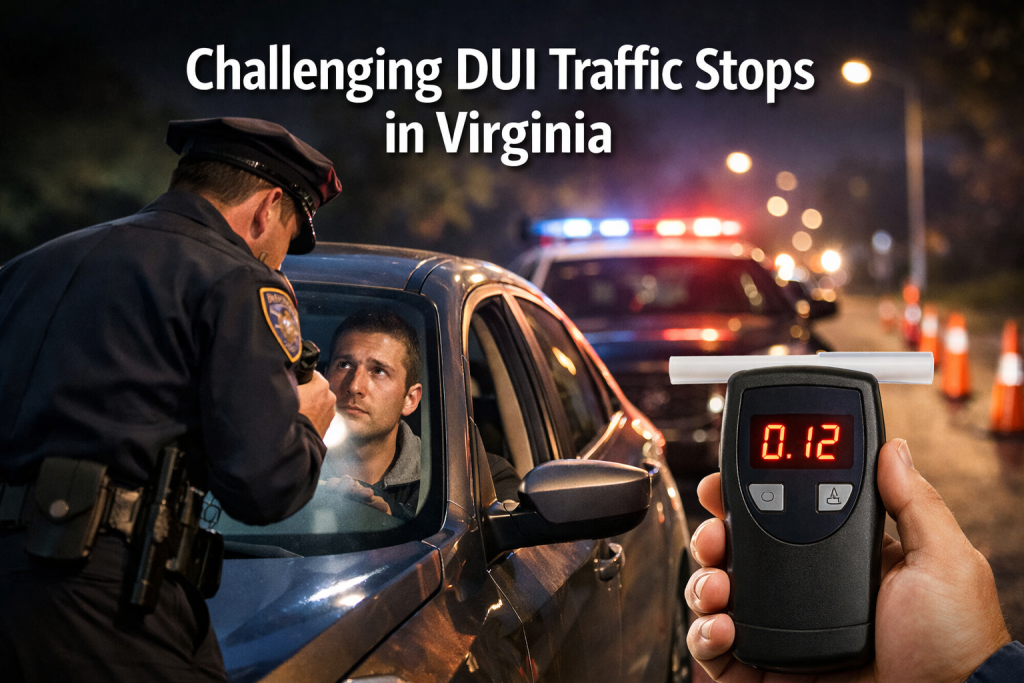
How DUI Stop Defenses Work in Virginia
If you were charged with driving under the influence after a traffic stop, one of the most important legal questions is whether the officer had a valid reason to stop your vehicle in the first place. In many Virginia DUI cases, the traffic stop is not just the beginning of the case. It can also become a key part of the defense strategy.
Police officers cannot stop a driver based on a hunch alone. They generally must have reasonable suspicion that a traffic violation, equipment issue, or criminal offense occurred. If the stop was not legally justified, important evidence may be challenged in court. That can include observations of alleged impairment, field sobriety testing, statements made by the driver, and in some cases the basis for an arrest.
For drivers in Virginia, understanding this defense can be extremely valuable. A DUI charge can affect your license, employment, insurance costs, and future opportunities. A careful review of the stop, the officer’s report, body camera footage, and any dash camera video may reveal weaknesses that are not obvious at first glance.
Why the Legality of the Stop Matters
In a DUI case, the prosecution often focuses on what happened after the stop, such as the smell of alcohol, bloodshot eyes, slurred speech, or a breath test result. But before any of that evidence comes into play, the stop itself must meet legal standards.
If an officer lacked reasonable suspicion to stop the vehicle, a defense attorney may file a motion to suppress evidence. This means asking the court to exclude evidence obtained through an unlawful stop. When that happens, the government may have a much harder time proving the case.
This defense does not automatically apply in every case, but it is especially important when the officer claims a vague or questionable reason for the stop. Even a small detail can matter, such as whether the driver actually crossed a lane line, whether a brake light was truly out, or whether the officer misinterpreted lawful driving behavior as suspicious.
Common Reasons Officers Stop Drivers
Officers in Virginia often cite one of the following reasons for a DUI stop:
Speeding, failing to maintain a lane, running a red light, expired registration, an equipment violation, or erratic driving. In some cases, the officer may claim the driver was weaving within the lane, braking suddenly, or driving too slowly. At other times, a stop may begin at a checkpoint or after a report from another motorist.
Not every stated reason will hold up under scrutiny. A defense lawyer may compare the officer’s explanation with video footage, dispatch records, and witness accounts to determine whether the stop was actually supported by the facts.
Examples of Stop Related Defenses in Virginia DUI Cases
The Officer Misread Ordinary Driving
Sometimes a driver makes a normal movement that an officer incorrectly treats as suspicious. For example, a driver may briefly touch a lane marker while avoiding road debris or adjusting to a curve. That alone may not justify a stop. If the officer exaggerated what happened, the defense may argue that the stop was based on innocent conduct rather than reasonable suspicion.
The Alleged Equipment Violation Did Not Exist
Another common issue involves brake lights, headlights, window tint, or license plate visibility. If the officer claimed there was an equipment problem, but photographs, repair records, or video suggest otherwise, that can weaken the prosecution’s justification for the stop. In some cases, the stop may be challenged because the officer was simply mistaken.
The Stop Happened After a Delayed Observation
Timing matters. If an officer claims to have seen a violation but waits too long to initiate the stop, questions may arise about whether the correct vehicle was stopped or whether the observation was reliable. This issue can become especially important on busy roads or at night.
The Stop Expanded Beyond Its Original Purpose
Even when a stop begins lawfully, the officer’s actions during the encounter may still be challenged. For example, if the original reason for the stop was a minor traffic matter, the officer generally cannot prolong the encounter without a valid legal basis. If the stop was extended improperly to investigate DUI, the defense may challenge what happened next.
What Evidence Can Help Challenge a Virginia DUI Stop
A strong defense often begins with a close review of the evidence. In Virginia DUI cases, useful materials may include the summons, arrest report, body worn camera footage, dash camera footage, 911 calls, dispatch logs, maintenance records, and photographs of the vehicle or roadway.
Sometimes the most important evidence is video. A report may describe dramatic weaving or dangerous driving, while the footage shows only a minor or isolated movement. Video can also reveal weather conditions, road markings, traffic patterns, and whether the officer’s stated observations match what actually occurred.
Witness statements can matter too. A passenger or another driver may be able to explain what the officer saw and why it was not suspicious. Physical evidence, such as a recently replaced bulb or a clear photo of the license plate, can also support the defense.
How This Defense Fits Into a Broader DUI Strategy
Challenging the stop is often only one part of a broader defense plan. A Virginia DUI lawyer may also examine whether field sobriety tests were administered properly, whether the officer had probable cause to arrest, whether chemical testing procedures were followed, and whether medical issues or fatigue could explain the driver’s appearance or performance.
That is important because even if a judge upholds the traffic stop, other defenses may still apply. Every case should be evaluated on its own facts. A driver may have several legal and factual arguments available, and the best defense strategy often comes from looking at the entire timeline from the first observation through the arrest and testing process.
Example Scenario
Imagine a driver in Northern Virginia is stopped late at night after an officer claims the vehicle was weaving. Body camera and dash camera footage later show the car remained mostly centered in its lane and briefly moved only once near a faded lane marker in a construction area. The driver is arrested for DUI after admitting to having a drink with dinner.
In that situation, the defense may argue that the stop lacked reasonable suspicion because the driving behavior was not illegal and did not reasonably suggest impairment. If the court agrees, the prosecution may lose access to critical evidence gathered after the stop.
What Drivers in Virginia Should Do After a DUI Arrest
If you were arrested for DUI in Virginia, it is important to act quickly. Write down everything you remember about the stop, including where it happened, what the officer said, how long the stop lasted, and whether any testing was performed. Save receipts, text messages, or location data that may help establish your timeline. If your vehicle allegedly had an equipment issue, document its condition as soon as possible.
You should also avoid making assumptions about the strength of the case based only on the charge itself. Many people believe that once an arrest happens, there is no meaningful defense. In reality, DUI cases can involve significant legal issues, especially when the traffic stop is weak, inconsistent, or unsupported by objective evidence.
An experienced defense attorney can review whether the stop was lawful, identify possible suppression issues, and determine how the facts fit into Virginia DUI law. Early investigation can make a major difference, especially before video is lost or memories fade.
Virginia DUI Defense Starts With the Facts
For many clients, the most effective defense begins by asking a simple question: was the officer legally allowed to stop the car? In Virginia DUI cases, that question can shape the entire case. A careful legal review may uncover problems with the officer’s observations, inconsistencies in the evidence, or constitutional issues that deserve serious attention.
If you are facing a DUI charge in Virginia, a detailed analysis of the traffic stop may be one of the most important steps in building your defense. The facts matter, the video matters, and the law surrounding traffic stops matters. Understanding those issues can help you make informed decisions about your case and your future.