
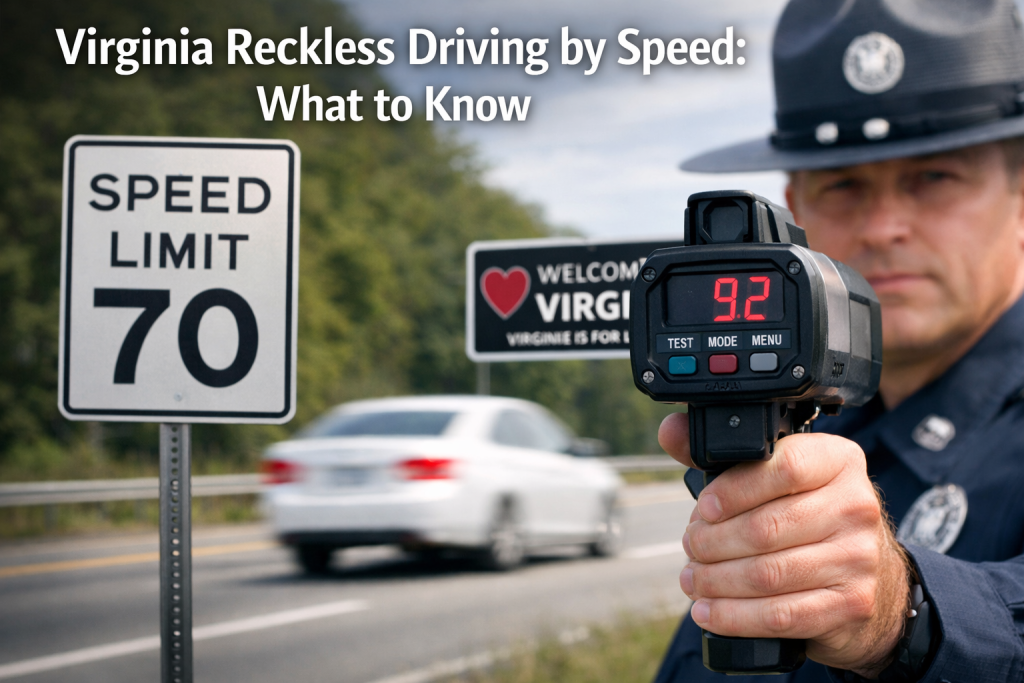
Reckless driving by speed is one of the most surprising criminal charges drivers face in Virginia. Many people assume a speeding ticket is always a traffic infraction, but in Virginia, driving fast enough can lead to a criminal charge with serious consequences. If you were stopped for excessive speed, understanding what this charge means and what steps to take next can make a major difference in your case.
Unlike a routine traffic citation, reckless driving in Virginia can carry the possibility of a criminal record, jail time, fines, license consequences, and increased insurance costs. For drivers in Northern Virginia and throughout the Commonwealth, this is not a matter to ignore or simply pay online without first understanding the impact.
What Is Reckless Driving by Speed in Virginia?
Under Virginia law, a driver may be charged with reckless driving by speed if they are driving at a speed that meets the legal threshold for this offense. In many cases, this applies when a person is driving 20 miles per hour or more above the posted speed limit, or over 85 miles per hour regardless of the speed limit.
This catches many drivers off guard. For example, a person traveling on I-95, I-66, or the Dulles Toll Road may think they are only going a bit too fast with traffic. But if the speed is high enough, the case can move beyond an ordinary speeding ticket and into criminal court.
Because this offense falls under the category of criminal charges, it should be taken seriously from the start. Even first-time offenders may face significant penalties depending on the speed alleged, the court, the judge, and the surrounding facts.
Why This Charge Is More Serious Than a Speeding Ticket
One of the most important things to understand is that reckless driving by speed is generally prosecuted as a Class 1 misdemeanor in Virginia. That means it is a criminal offense, not just a traffic infraction.
A conviction can potentially result in:
Fines imposed by the court
Possible jail time in more serious cases
Suspension of your driver’s license
Six demerit points on your Virginia driving record
A permanent criminal record unless the charge is dismissed or reduced
Substantially higher insurance premiums
Collateral consequences can also extend beyond the courtroom. A criminal traffic conviction may affect employment, security clearance issues, professional licensing, and background checks. This is especially important in Virginia, where many residents work in government, defense, healthcare, education, or regulated professions.
Common Situations That Lead to Reckless Driving Charges in Northern Virginia
Drivers are often charged with reckless driving by speed in situations that seem ordinary at first. Some common examples include:
Fast highway travel
A driver on a long highway trip may gradually increase speed without realizing how fast they are going. Roads such as I-81, I-95, Route 28, and I-495 are common locations for these stops.
Keeping up with traffic
Many people believe that matching the speed of surrounding vehicles will protect them from a charge. Unfortunately, if your speed meets the reckless driving threshold, that argument usually does not prevent a citation.
Downhill acceleration or inattention
Sometimes a driver simply loses track of speed on a downhill stretch or while passing another vehicle. Even a brief period of excessive speed can trigger a criminal charge.
Out-of-state drivers unfamiliar with Virginia law
Visitors from Maryland, Washington DC, or other states are frequently shocked to learn that conduct treated as a serious speeding ticket elsewhere may be charged criminally in Virginia.
How Virginia Courts Evaluate These Cases
Every reckless driving case depends on its facts. The posted speed limit and alleged speed matter, but courts may also consider additional details when deciding how to handle the case.
Relevant factors often include:
How far above the speed limit the driver was alleged to be
Road, weather, and traffic conditions
Whether there was an accident or dangerous driving behavior
The driver’s prior record
Whether the driver completed a driver improvement course
Whether the speedometer was calibrated and documented
Whether the prosecution can support the charge with reliable evidence
In some cases, the defense may challenge how speed was measured. Officers may use radar, lidar, pacing, or other methods. The legal sufficiency of that evidence can become an important issue. In other situations, the focus may be on negotiating a reduction or presenting mitigating evidence to the court.
Reckless Driving by Speed in Virginia: Possible Defenses and Strategies
There is no single defense that applies in every case, but several strategies may help depending on the circumstances. A criminal defense attorney can evaluate the facts and determine the strongest approach.
Questioning the speed evidence
The prosecution must prove the case. If there are issues with radar calibration, lidar use, officer observations, or documentation, those weaknesses may affect the outcome.
Presenting a clean driving record
A driver with little or no prior record may be in a better position to seek leniency or a reduction.
Showing proactive steps
Completing a driver improvement course, obtaining a speedometer calibration, or gathering other favorable documents can sometimes help show responsibility and reduce the perceived seriousness of the incident.
Negotiating for a reduced charge
Depending on the facts, some cases may be resolved through a reduction to improper driving or a traffic infraction. This can be significant because avoiding a criminal conviction is often the primary goal.
What to Do After a Reckless Driving Charge in Virginia
If you are charged, your response matters. A few practical steps can help protect your position.
Read the summons carefully
Make sure you know your court date, the exact charge, and the alleged speed. Missing court can create additional legal problems.
Do not assume you should just prepay
In many reckless driving cases, prepaying is not an option, and even if a payment option appears available in another type of case, paying a citation can amount to admitting guilt. For a criminal traffic charge, legal advice is important.
Gather documents
Obtain your driving record, proof of driving school if completed, and any information about your vehicle, including speedometer calibration if appropriate.
Speak with a defense lawyer promptly
Early legal guidance can help you understand your exposure, possible defenses, and the best way to present your case in court.
Special Concerns for Maryland and Washington DC Drivers Charged in Virginia
Many drivers who live in Maryland or Washington DC are cited in Virginia while commuting, traveling for work, or visiting family. These drivers often underestimate the seriousness of the situation because they are comparing the charge to how it might be treated in their home jurisdiction.
That can be a costly mistake. A Virginia reckless driving conviction may still affect your driving privileges, insurance, and record. It may also require you to appear in a Virginia court, even if you live elsewhere. If you are from Washington DC or Maryland and received this charge in Virginia, it is especially important to understand the local court process rather than assume the matter will be handled like a standard ticket back home.
When to Contact a Virginia Criminal Defense Attorney
Because reckless driving by speed is a criminal charge, it is wise to seek legal advice as soon as possible. This is especially true if the alleged speed was very high, there was an accident, you hold a commercial driver’s license, you have prior violations, or your job could be affected by a conviction.
An attorney can review the summons, examine the evidence, identify weaknesses in the case, and help pursue the best possible result. In many situations, the goal is not only to reduce immediate penalties but also to protect your long-term record and future opportunities.
Final Thoughts on Reckless Driving by Speed in Virginia
A reckless driving by speed charge in Virginia is far more than an ordinary traffic ticket. It is a criminal allegation that can carry lasting consequences for drivers in Virginia, Maryland, and Washington DC. If you are facing this type of charge, taking it seriously from the beginning is one of the most important decisions you can make.
Understanding the law, preparing the right documentation, and getting informed legal guidance can improve your chances of a better outcome. For many people, the key issue is avoiding a criminal conviction and limiting the impact on their license, record, and livelihood.