A past felony conviction does not always mean you are permanently barred from jury service in Maryland. Eligibility can depend on whether your civil rights have been restored, and finishing a sentence does not necessarily settle the question by itself. If you receive a jury summons, do not ignore it or assume you are disqualified. Check your current status with the court that sent it and follow the instructions provided.
Does a felony conviction make you ineligible for Maryland jury duty?
Maryland jury service rules generally treat a felony conviction as relevant to eligibility. A person convicted of a felony may be disqualified unless their civil rights have been restored. That means the conviction alone may not give you the complete answer: your status after the conviction matters too.
Whether rights have been restored can depend on the applicable law and the details of your case. The type of conviction, the sentence, and whether the sentence has been completed may all be relevant. Do not rely on a general assumption, such as “I finished probation, so I must qualify” or “I have a felony, so I can never serve.” Ask the court to assess your circumstances.
What changes after you complete your sentence?
Completing a prison term, probation, or parole can be an important part of a person’s post-conviction status. But it does not automatically answer every question about jury eligibility. Different civil rights can have different restoration rules, and rules may change over time. The answer for jury service should be confirmed with the appropriate court rather than inferred from another legal right.
For example, someone may know that a particular right has been restored after release from incarceration. That does not necessarily establish that every other right has been restored for every purpose. Jury service has its own eligibility requirements, so a voter registration, driver’s license, or other record should not be treated as proof of jury qualification.
If your sentence is not fully complete, or you are still on probation or parole, explain that accurately when you contact the court. Do not leave out details because you think they might make you ineligible. The court can tell you what information it needs and whether you should respond in a particular way.
What should you do if you receive a jury summons?
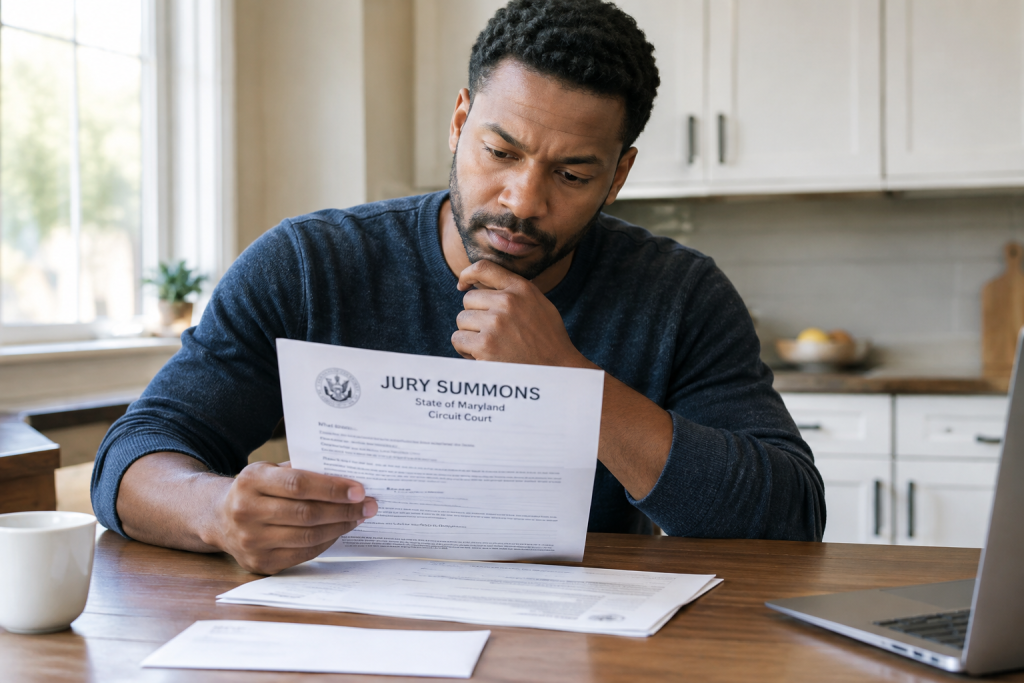
Read the summons carefully, including its deadline and instructions for completing the questionnaire. A summons is not a finding that you are eligible, nor does a past conviction automatically make it safe to disregard. Respond by the date stated, even if you believe you cannot serve.
Use the contact information on the summons or the official Maryland Judiciary website to reach the jury office for the court named in the notice. Explain that you have a felony conviction and ask how the court determines whether your civil rights have been restored for jury service. Follow the court’s directions for submitting any requested information.
Keep a copy of your response and note when and how you contacted the court. If you have documents showing the outcome of your case or completion of your sentence, ask whether the court wants them. Do not send sensitive records unless the court tells you how to provide them safely.
Information that may help when you contact the court
Be prepared to give the jury office basic information, such as the court and summons number, the jurisdiction where the conviction occurred, and the general status of your sentence. The court may ask for more details to assess eligibility. You can ask what documents are needed before sending anything.
If the conviction happened outside Maryland, mention that as well. A different state’s rules and records may affect how the court evaluates your status. If you are unsure whether an old case was classified as a felony, do not guess. Ask how to verify the record or seek legal assistance.
Can you simply ignore the summons if you have a felony?
No. Ignoring a jury summons can create a separate problem, even if you believe you are not eligible. The summons explains how to respond and whom to contact. If you are uncertain, contact the jury office promptly and ask how to report the conviction or request a determination.
Do not assume that the court already knows your complete criminal history or has decided the issue. Jury questionnaires help the court check qualifications and identify situations that need review. Give truthful answers and ask for clarification if a question is unclear.
What if the court says you are not eligible?
If the jury office tells you that you are disqualified, follow its instructions and keep any confirmation. If you think the decision is based on incorrect information, ask how to correct the record or request a review. For example, you may have documents showing that a case was dismissed, that the conviction was not a felony, or that your rights were restored.
A clerk or jury staff member can explain court procedures, but may not be able to give legal advice about how restoration laws apply to your case. If the answer is unclear, the record is complicated, or the decision could affect other rights, consider speaking with a Maryland attorney. An attorney can review the conviction and sentence records and help you understand what questions to raise.
Common misunderstandings about felony convictions and jury service
- “Every felony conviction bars me forever.” Not necessarily. Restoration of civil rights may affect eligibility, so confirm your current status.
- “Finishing my sentence automatically makes me eligible.” Do not assume that sentence completion alone resolves the jury-service question.
- “A summons means the court has already approved me.” A summons asks you to respond; the court may still need to evaluate your qualifications.
- “I can ignore the notice because I have a conviction.” Respond as directed and ask the jury office how to report your circumstances.
How to check your Maryland jury-service eligibility
The practical answer is to respond to the summons and ask the court to confirm your eligibility. Explain the felony conviction honestly, describe whether your sentence is complete, and provide documents only as requested. Do not assume that a completed sentence automatically restores jury eligibility or that a conviction always creates a permanent bar.
If you cannot get a clear answer, or you need to understand how your particular conviction affects your rights, seek advice from a qualified Maryland attorney. Checking before the response deadline can help you avoid missed notices and give the court a chance to assess your circumstances accurately.